
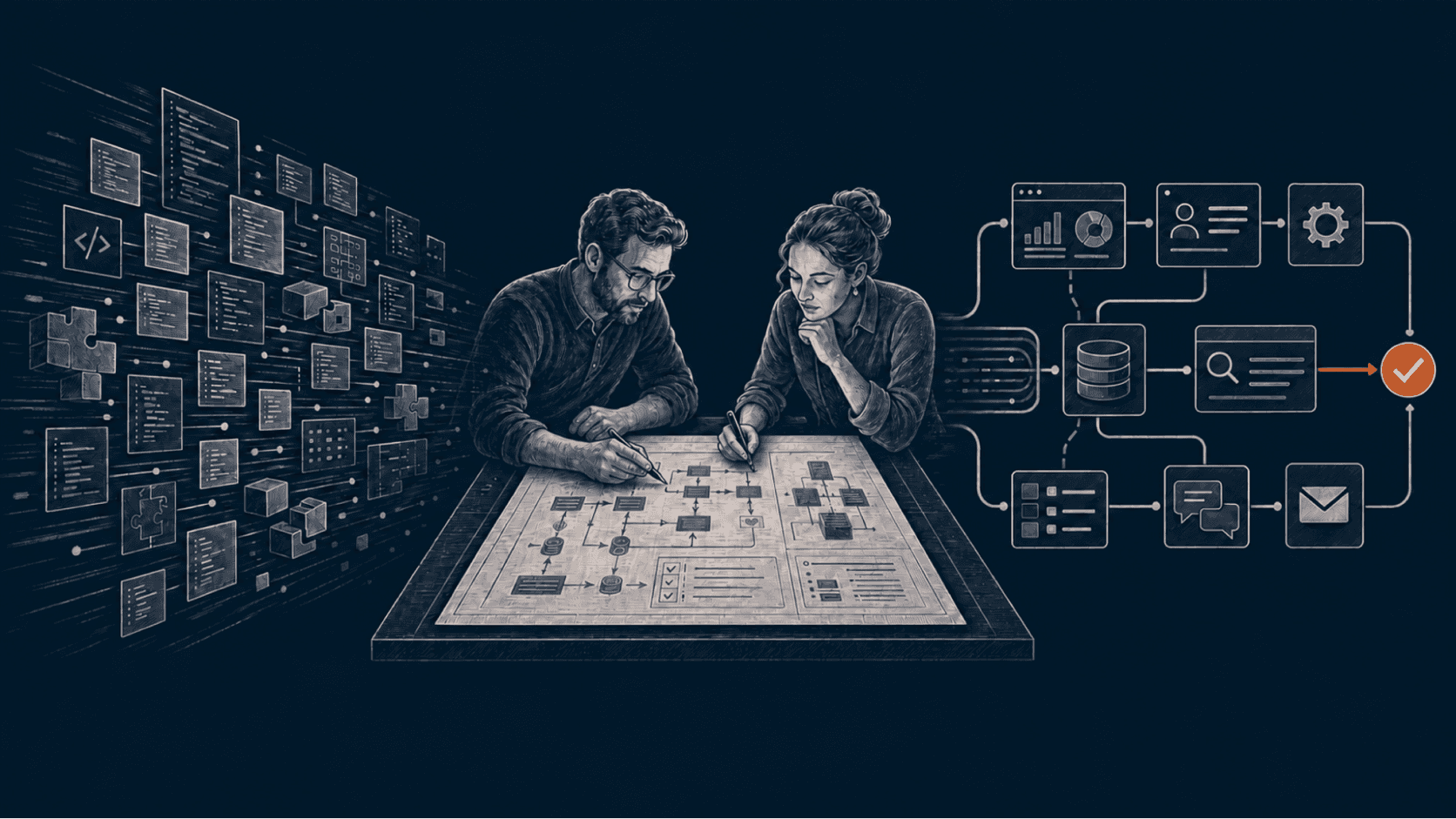
AI can produce more software, more quickly. The advantage is moving to teams that understand what should be built, how work should change, and where human judgement must remain.
Recently, Ode with Anthropic publicly introduced its name and offering. It helps companies put frontier models into their operations through small teams of "applied AI engineers".
The company was formed by Anthropic, Blackstone, Hellman & Friedman, and Goldman Sachs, with other large investors behind it. TechCrunch reported its valuation at $1.5 billion.
That figure is a market signal, and doesn't mean that every company needs an AI services firm. But the useful detail is what Ode sells: engineers who work closely with a company, understand its operations, and build AI systems around the work.
Anthropic's announcement describes a typical engagement as a small team first learning where Claude can have the greatest impact, then developing systems tailored to the organisation. The model is just a part, but the work begins with operational understanding.
Investors have placed a large bet on the layer between a capable model and a working business system. Our reading is that they have priced the judgement layer, or more plainly, the design layer.
What cheaper code actually means
"Code is getting cheaper" needs a boundary. Production software still has to survive real users, sensitive data, changing requirements, security reviews, integrations, maintenance, and failures.
The often-cited 19 per cent slowdown from METR belongs to a controlled study run between February and June 2025. In a February 2026 update, METR said its late-2025 follow-up leaned towards speed-ups, but could not produce a reliable current estimate because developers who valued AI most were less willing to participate and high-uplift tasks were increasingly left out.
A July 2026 preprint tracking 802 developers at one AI-forward company found that per-capita pull-request throughput reached 2.09 times the level recorded before the company's AI productivity mandate by April 2026. Review load per reviewer roughly doubled.
The authors treated the company as a favourable case and could not attribute the whole gain to AI because adoption was not random. So the claim remains narrow: current coding agents can support much higher output in some settings, but the benefit depends on the task, team, codebase, and the system available to review and absorb the work.
Uber found the design layer inside the workflow
On July 7th, Uber CTO Praveen Neppalli Naga wrote that 99 per cent of the company's engineers used AI tools, more than 70 per cent of pull requests were attributed to agents, and its engineers had built more than 2,500 agent skills.
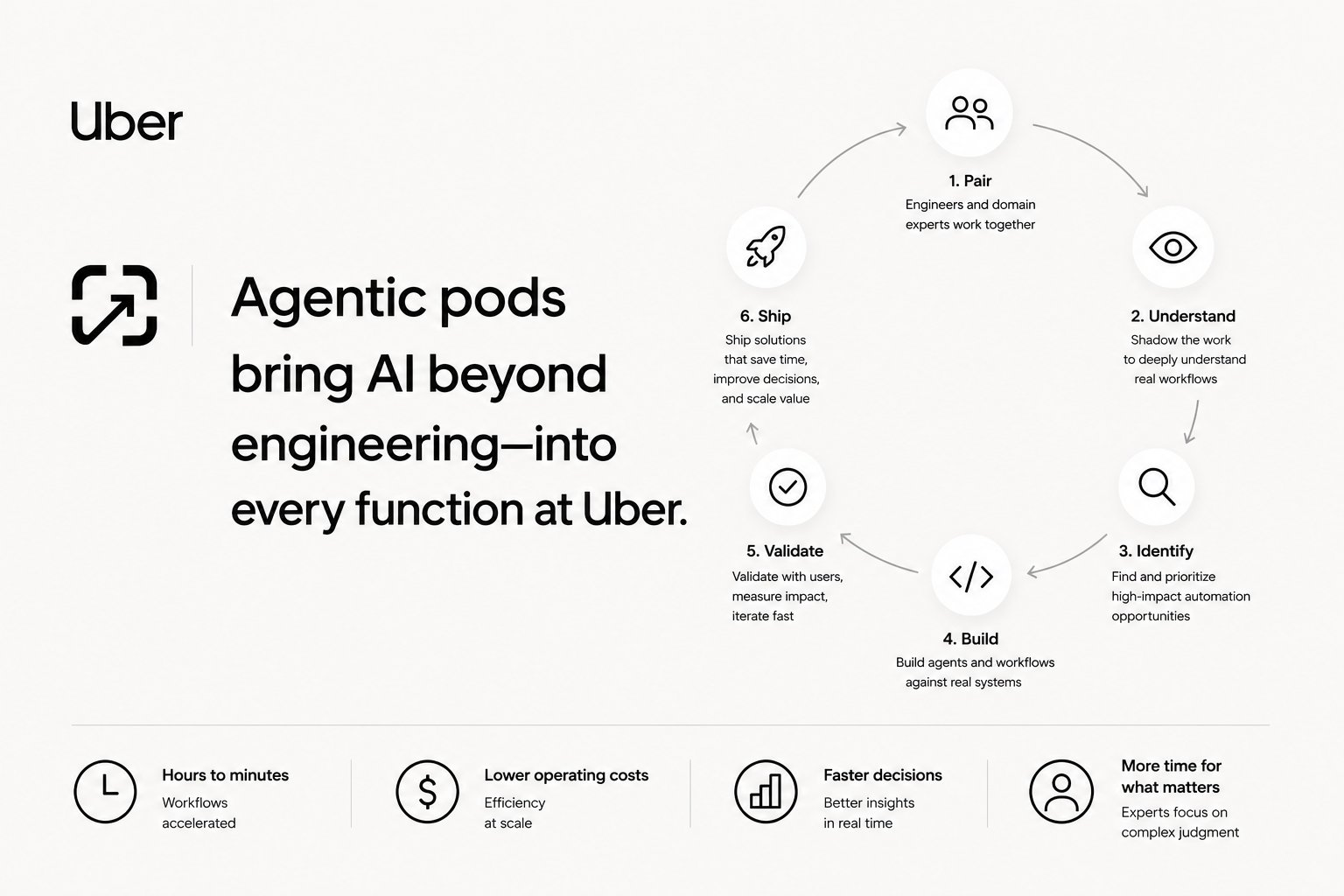
Uber's six-stage Agentic Pod method. Source: Uber CTO Praveen Neppalli Naga on X.
To extend the approach beyond engineering, Uber paired roughly thirty AI-proficient engineers with domain experts. Each Agentic Pod had ten working days to understand and change a workflow.
The pairs spent two days shadowing the work, prioritised opportunities on day three, then built alongside the operator and tested the result with colleagues before shipping. The sequence put observation and validation before automation.
Neppalli reported sixteen pods across sixteen business functions in two months. Reported outcomes included capital allocation across 150 cities falling from fifteen hours to thirty minutes, financial pacing reports from two days to ten minutes, and marketing web quality assurance from two weeks to fifty minutes.
Those are Uber's own figures, not independently audited benchmarks. More useful is the method: engineers sat beside people who knew where information arrived late, which exceptions mattered, why approvals existed, and what a good result looked like.
So, Uber's phrase was that "the workflow becomes the unit of automation". That is where the design layer becomes visible.
Design is the work around the code
"Design" here goes beyond the appearance of an interface. It includes the workflow, system architecture, permissions, hand-offs, review, and evidence needed to judge an outcome.
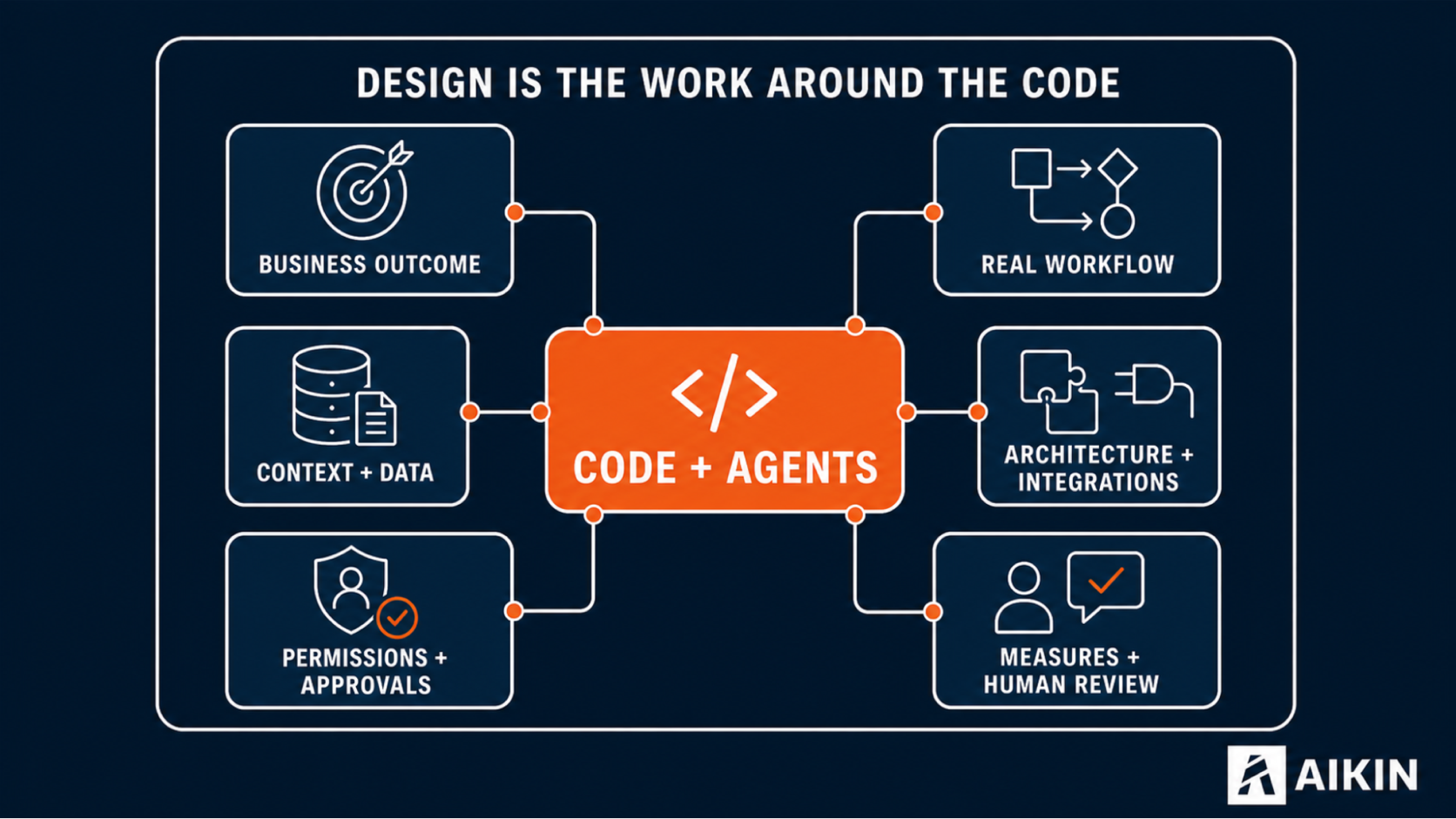
Code is one component. The design layer determines where it works, what it can access, and how its output is judged.
A model can generate an integration, but general training data cannot tell it which client record is authoritative, why a partner reviews one class of work, which unofficial spreadsheet closes a gap, or what the firm will defend when something goes wrong.
Much of that knowledge sits across people and documents, and appears only when someone watches the work and follows its exceptions. The scarce input is the judgement needed to turn that knowledge into an accurate specification.
Senior people therefore need to define outcomes, make architectural choices, expose hidden constraints, set approval boundaries, and decide whether the result is good enough. AI can assist, but it needs the right context and an accountable person or team at the final decision.
Faster output can magnify a weak system
DORA describes AI as an amplifier of the organisation around it. Clear workflows, strong internal platforms, fast feedback, and reliable testing help teams turn more coding capacity into better delivery.
Without those foundations, teams can generate more change than they can review. A DORA analysis published in March 2026 found that AI often accelerates prototyping while production integration, edge cases, and review absorb much of the saved time.
Cheaper execution can therefore make poor design more expensive. A weakly chosen problem can produce a large volume of code, agents, integrations, and review work before anyone asks whether the workflow should exist in that form.
More output helps only when the team can select, shape, and verify it.
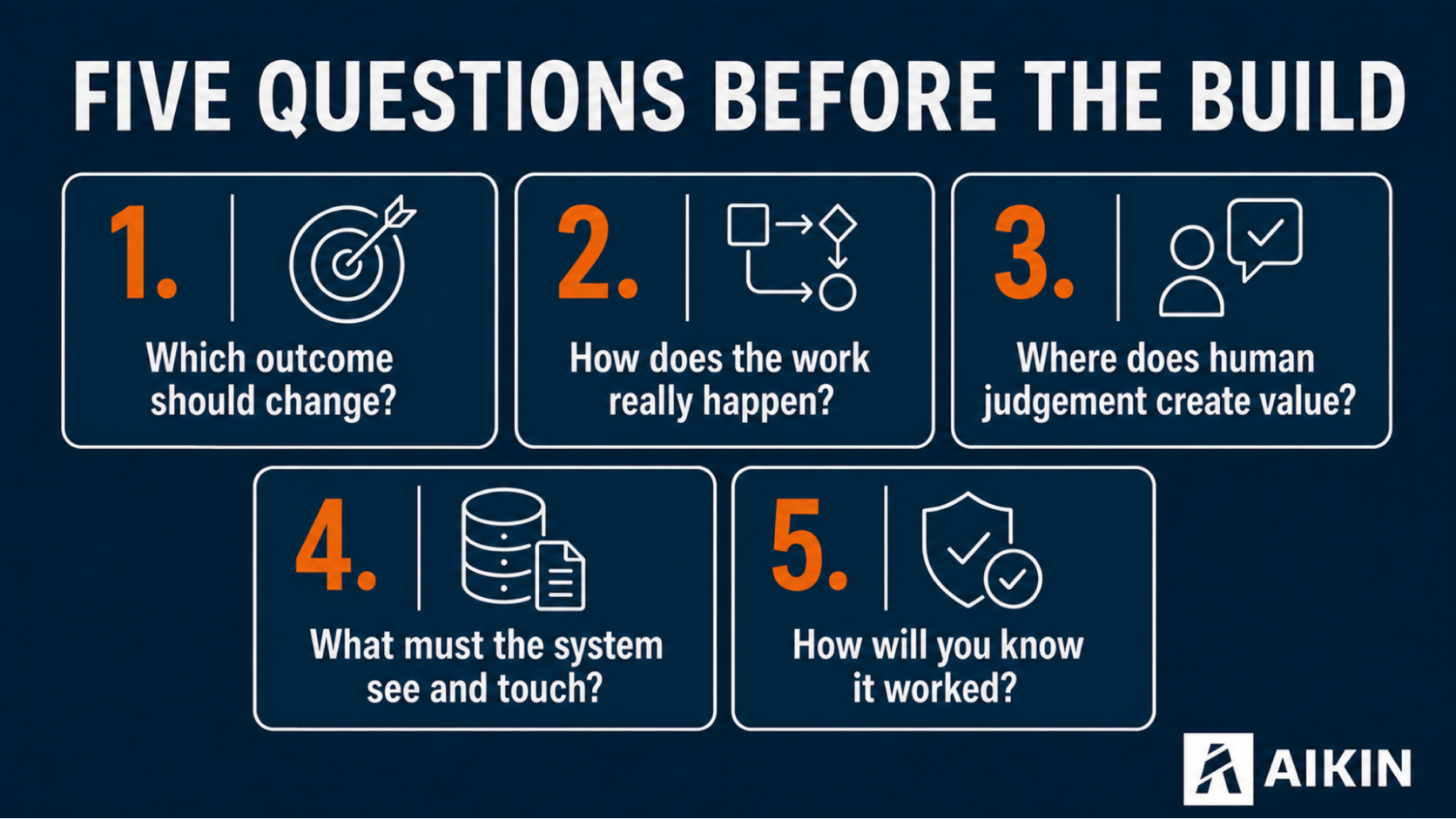
Leaders should answer five questions before treating an AI prototype as an operating system.
- Which outcome should change? Name the business result, not the agent or feature.
- How does the work really happen? Follow the live workflow, including exceptions, side channels, and delays.
- Where does human judgement create value? Separate delegated decisions from those needing accountable review.
- What must the system see and touch? Define its data, tools, permissions, memory, and boundaries.
- How will you know it worked? Decide what to measure, who reviews quality, and who owns failures.
These questions are design work. Better models may change the answers, but they do not remove the questions.
Intent, execution, and verification
Aikin's delivery model separates human intent, AI-orchestrated execution, and human verification. AI takes on more production, while people define what matters and decide whether the result meets the standard.
We start with how a firm operates. An Agentic OS needs the workflows, integrations, context, permissions, review paths, and outcome measures that turn agent capability into dependable work.
As code generation becomes faster, advantage moves towards firms that can see their work clearly enough to redesign it, then give AI precise boundaries and a result worth verifying.
Before asking what AI can build, map what should change.
~ From Nicholas O'Neill and the Aikin team.
FAQ
Is AI making software development cheaper?
AI lowers the effort needed to produce and iterate on code in many settings, but the effect varies by task and team. Integration, security, testing, review, and maintenance still shape the total cost.
What does the design layer mean in AI-assisted development?
The design layer contains the decisions around the code: the outcome, workflow, architecture, context, permissions, human review, and measures of success.
Why map a workflow before building an AI agent?
A workflow map exposes the hand-offs, exceptions, judgement points, systems, and approval rules that a generic agent cannot infer from a task description.