
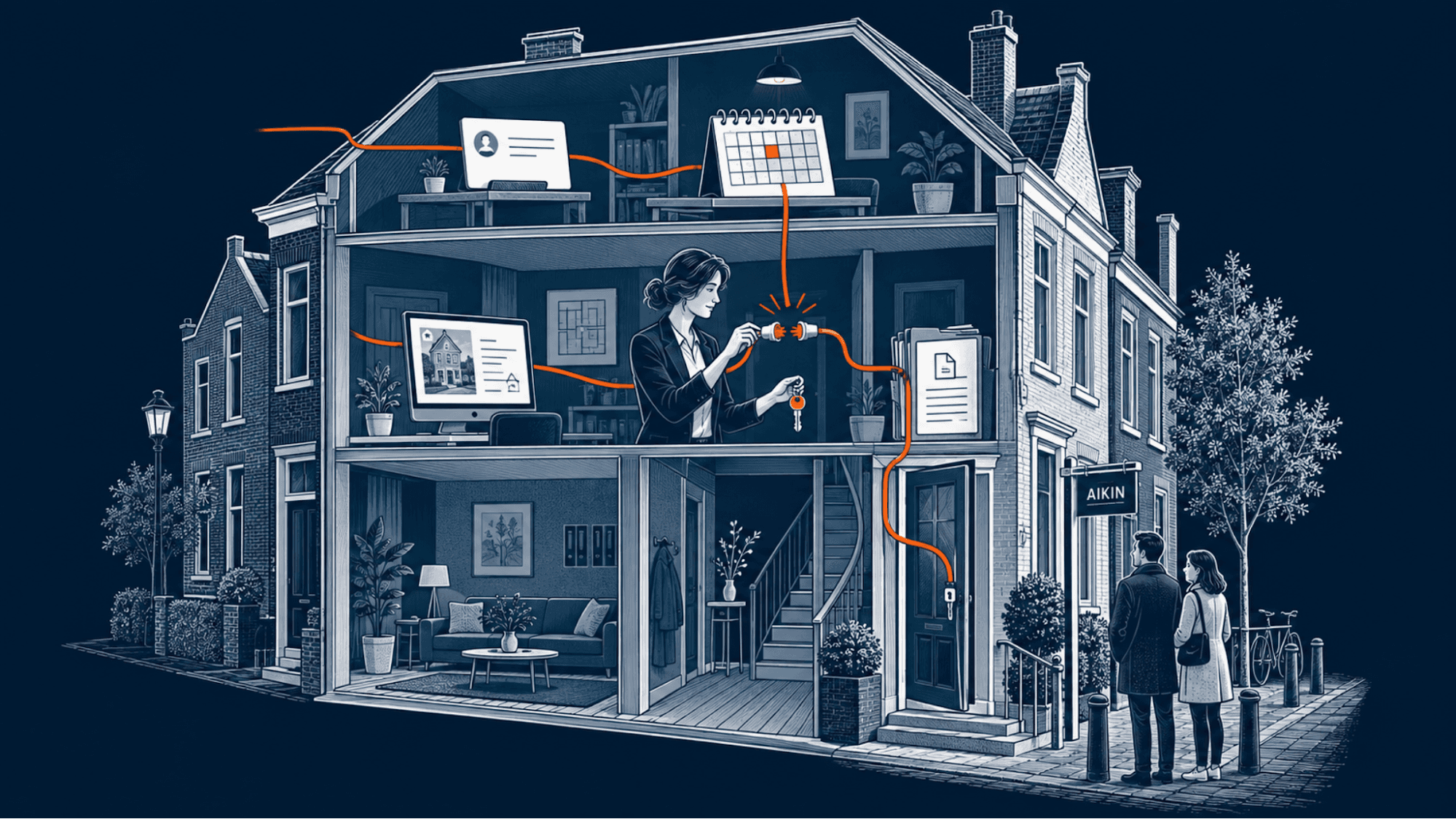
The tools already do useful work. The question is what still depends on a person to carry context, resolve exceptions and close the loop.
Imagine an enquiry arrives after the office closes. A buyer asks whether a flat is still available and wants to arrange a viewing.
Even with capable tools, somebody may still have to carry context between them and resolve whatever does not fit. That coordination is the work around the deal, and it can quietly consume the makelaar's time.
Depending on the agency's setup, the CRM may capture the lead, send a booking link and update the status when a slot is chosen. It's useful that the system has handled the normal path.
Then the buyer adds that two people need to attend, their current home still has to be sold and none of the offered times work. The useful information now sits across a message, a calendar, a property record and somebody's knowledge of the seller.
So, a person picks up the thread. They check the details, ask the right follow-up, agree an exception, update the CRM and brief the makelaar.
Every tool may have worked as intended. Yet a person still had to make the workflow work.
Now look at your calendar and inbox from last week. How much time went into valuations, negotiations and winning a seller mandate, and how much went into moving information, chasing answers and keeping the process together?
The work around the deal
Split the week into two kinds of work. The first depends on professional judgement: valuing a property, reading a negotiation, handling a sensitive call or earning a seller's trust.
And then there is the coordination around it. Leads need answers, viewings move, records need updating and missing documents have to be chased.
A good binnendienst, or office support team, can take on much of that coordination. For some agencies, that is the right answer.
But the work has still moved to another person. Someone remains responsible for carrying context between systems and noticing when the normal path no longer fits.
The same test appears in our article about senior people in design agencies: separate the work that earns its place through judgement from coordination that needs a human connector.
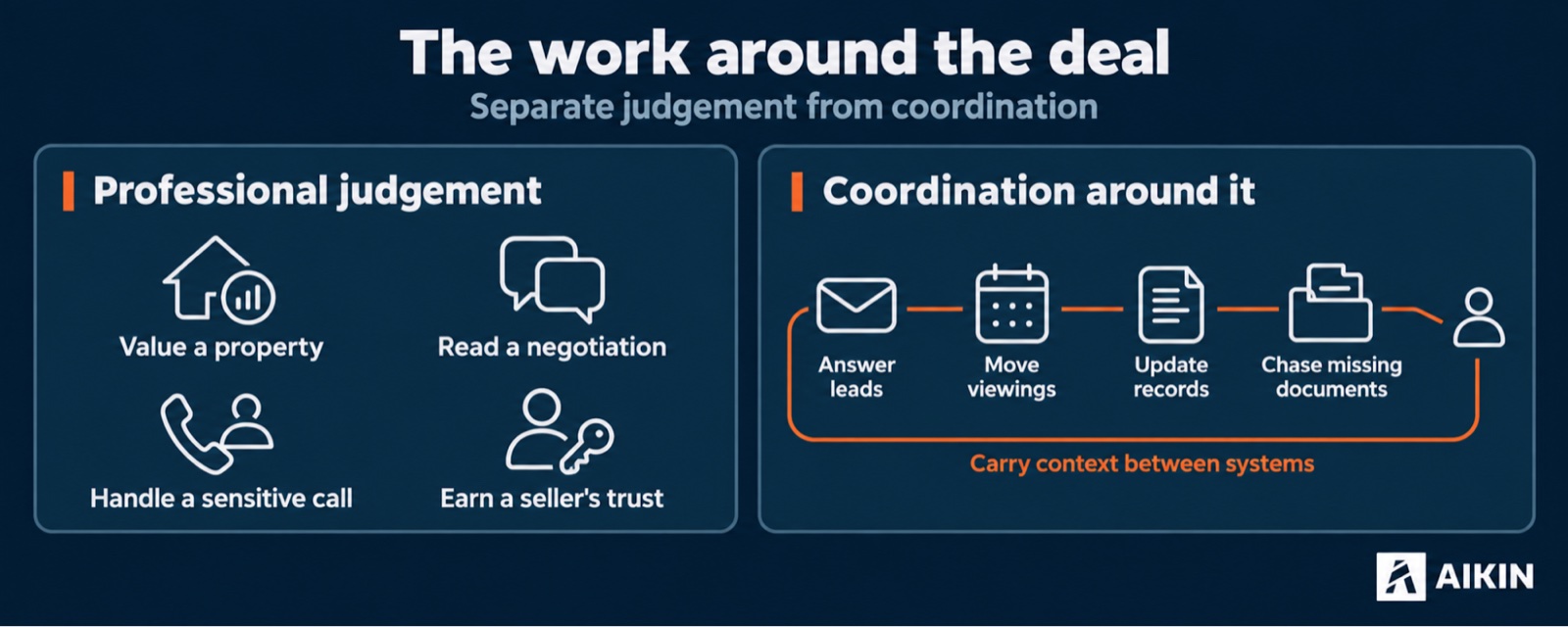
Separate the work that needs a makelaar's judgement from the coordination somebody still has to carry between systems.
Your existing stack may already be enough
Current documentation from a Dutch property CRM shows how much of the ordinary path can already be covered. Portal enquiries can enter a lead overview, while prospects can receive a viewing link, booked appointments can appear in the calendar and lead statuses can update automatically.
And current vendor pages advertise focused AI products that answer initial questions, qualify leads and pass information into a CRM or qualify enquiries and arrange viewings across connected tools. For a bounded problem, that may be all the agency needs.
Start by checking what you already own. A feature that is poorly configured, barely used or missing a clear owner does not automatically justify a new system.
If better CRM setup closes the gap, keep the CRM. If one point tool solves one bounded problem and handles its exceptions well, use that.
The case for an operating layer begins later, when the same work repeatedly crosses several systems and somebody must keep the context, rules and outcome intact between them.
Find the human glue
Human glue is the part of a workflow that exists in somebody's head, inbox or daily routine. It appears when a person copies information, remembers what happened earlier, interprets an exception or repairs a broken handoff.
In the viewing request, the easy path is a lead, a valid slot and a booking. The exception adds another buyer, a property to sell and a schedule the standard options cannot handle.
Then somebody has to decide what matters. The agency may need to capture a possible sales instruction, confirm what can be promised, find a workable appointment and leave the record clear for whoever takes over.
To find that work in your own agency, trace one real process and ask:
Where does somebody copy or re-enter information?
What happens when information is missing, conflicting or sensitive?
Which message, decision or external action needs human approval?
Can the team see what happened and recover when a step fails?
Who owns the workflow when a tool, rule or process changes?
If every answer stays inside one product and the exception path is acceptable, improve that product. A broader build would add cost and maintenance without solving a broader problem.
But if the same lead moves through a portal, CRM, calendar, email or WhatsApp, and later a dossier, the handoffs deserve attention. Repeated exceptions are where a collection of useful features can still leave a person running the process between them.
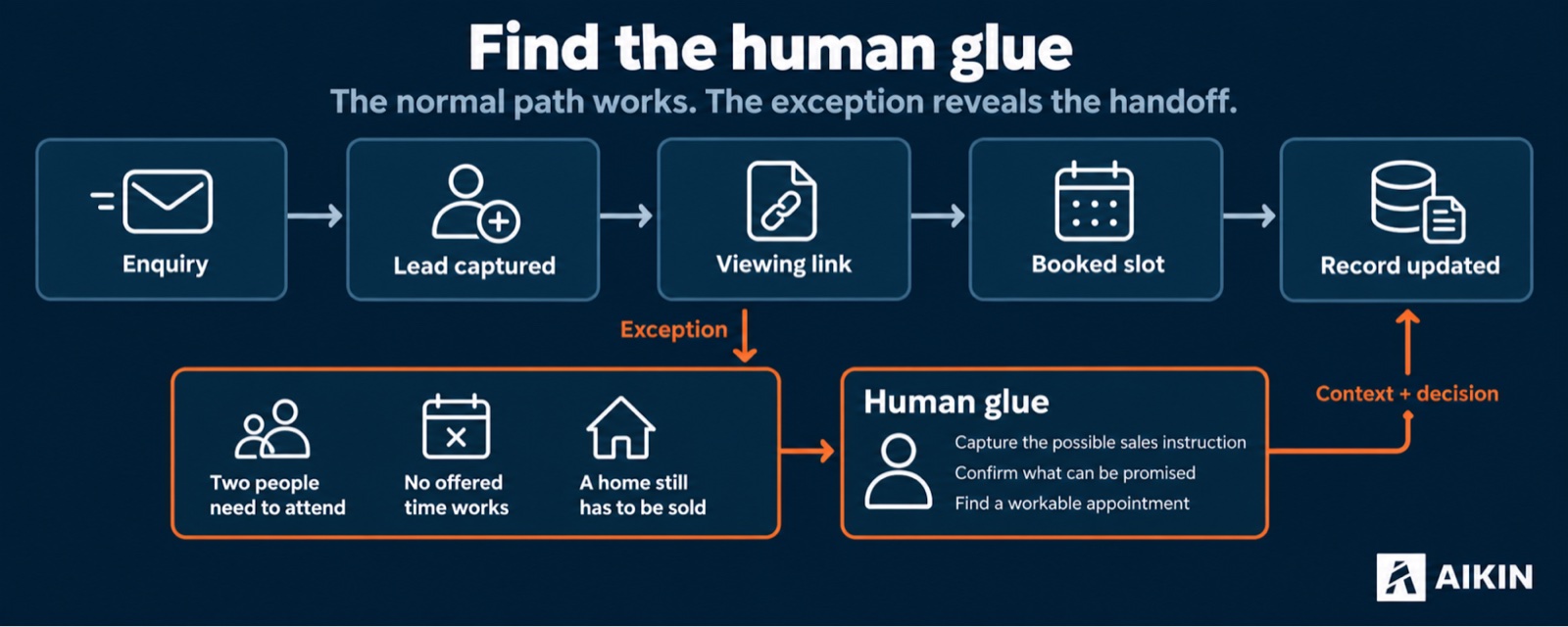
The easy path can run through the tools. The human glue appears when the enquiry no longer fits that path.
Choose the smallest useful intervention
Start with configuration when the workflow sits mainly inside one system and the missing step is already available.
Then add a point tool or conventional automation for a bounded gap, such as qualifying an enquiry or drafting listing copy. The team still needs to see failures and own the setup.
An operating layer only earns its place when recurring work crosses systems, several steps depend on shared context, exceptions need routing and consequential actions require clear approval.
The distinction matters because every new system brings maintenance. A small problem should keep a small solution.
What an operating layer changes
For a real-estate agency, an Agentic OS is the layer that carries agreed work across the tools the agency already uses, while keeping context, permissions, approvals, outcomes and ownership visible.
In the viewing example, that layer could read the approved property information, collect missing details, propose an allowed slot, update the correct record and route an exception to a person. When the makelaar steps in, the conversation and its current state arrive together.
And the same design can support other work around the deal: preparing a listing draft, assembling a client update, gathering research for a valuation or flagging a stalled file. Each use still needs its own data, rules, success test and human boundary.
One workflow may need one AI agent, several, or none. As How Many AI Agents Do You Actually Need? explains, the boundaries should follow real differences in tools, permissions, evaluation, context and memory rather than copy job titles.
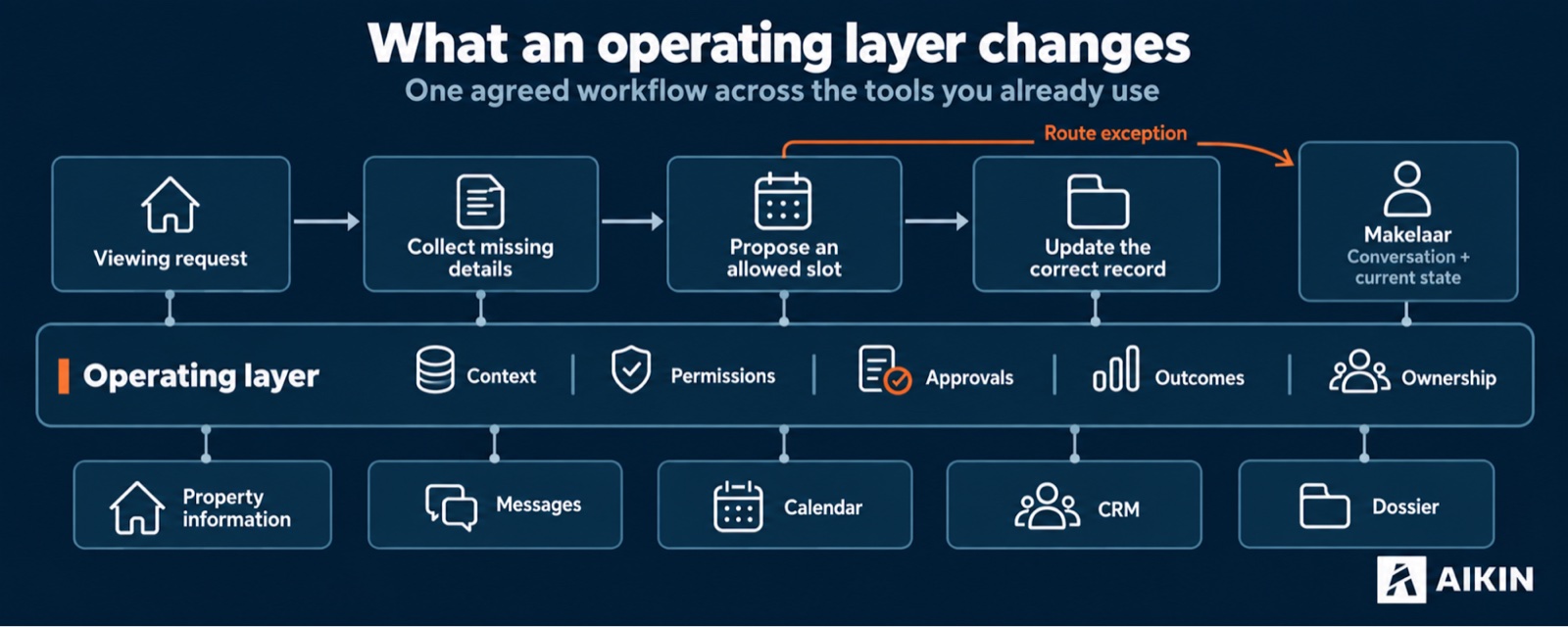
The operating layer carries one agreed workflow across existing tools and routes the exception with its context intact.
Keep judgement where it earns its place
A system can prepare the information for a valuation, but the makelaar remains responsible for the professional judgement. It can draft a follow-up, while a person handles negotiation, a sensitive exception or a promise that could affect the client.
Place human involvement where it changes the quality or accountability of a decision. Approval on every harmless step recreates the bottleneck; no approval on consequential steps creates a different problem.
And when AI speaks directly to a prospect, Article 50 of the EU AI Act may require the agency to tell them that they are interacting with AI.
Dutch estate agents also have Wwft customer-due-diligence duties for relevant property mediation. Scope matters: an automated viewing link is different from an AI conversation or a due-diligence decision.
Start with the workflow, not the agent list
Aikin starts by mapping how one real workflow moves through the agency: the normal route, its exceptions, every system touched and the decisions that should stay with a person.
Then the agency defines one outcome worth improving and chooses the smallest intervention that can deliver it. That may mean using the CRM better, adding one tool or designing an operating layer.
Take one enquiry from last week and trace it from the first message to the final record. Mark each point where somebody copied information, searched for context, made an exception or repaired a handoff.
If the trail stays inside one tool, improve that tool. If it repeatedly crosses systems and depends on people to hold it together, map the workflow with Aikin.
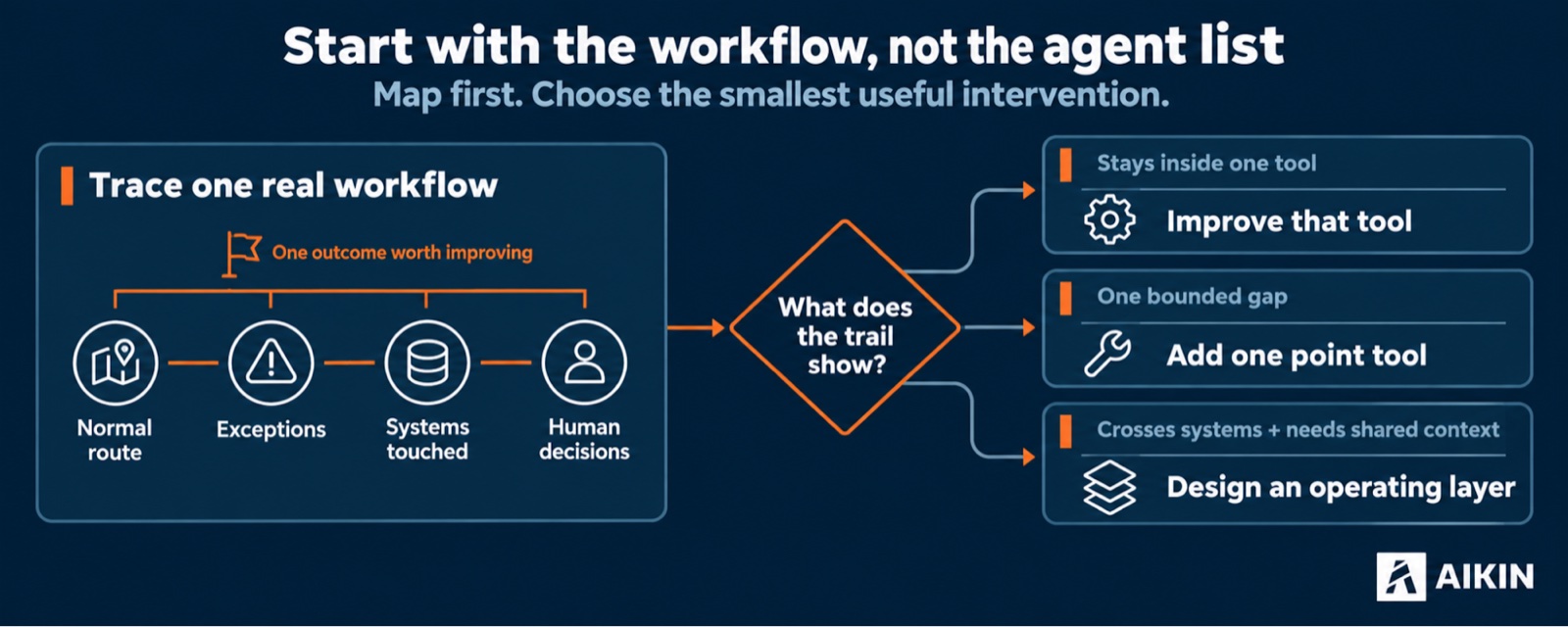
Map the workflow first. Then choose the smallest intervention that closes the real gap.
~ From Nicholas Oneill and the Aikin team
FAQ
What is an Agentic OS for a real-estate agency?
It is the operating layer that carries agreed work across the agency's existing tools, with shared context, permissions, approvals and ownership. It should use the CRM as its system of record where that CRM already holds the right relationships, properties, appointments and history.
Which real-estate workflow should an agency automate first?
Start with a recurring workflow that has a clear outcome, visible handoffs and a safe escalation path. Lead-to-viewing can be a useful candidate, but only after checking what the current CRM and point tools already cover.
How much of the workflow should stay human?
Keep people responsible for valuation, negotiation, sensitive client communication and consequential exceptions. Let the system prepare context and handle bounded coordination where its actions can be checked.
Does one workflow need several AI agents?
No. Use a separate AI agent only when the work needs a real boundary, such as different permissions, context, memory or evaluation; otherwise, one agent with the right skills may be simpler to run.