
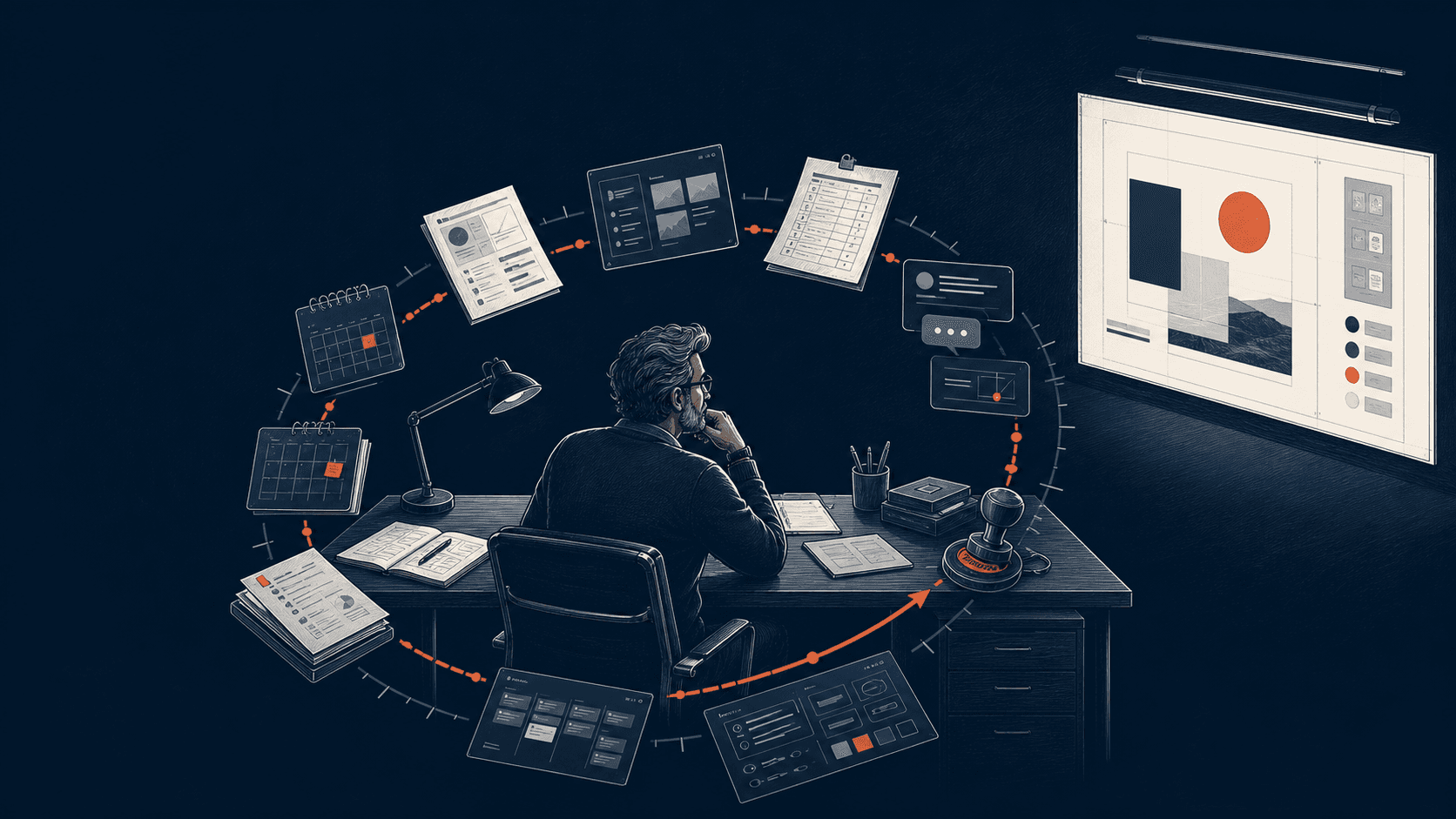
A design agency runs on the time of a few senior people, and most of that time goes to work that isn't the craft: winning the work, coordinating it, chasing feedback, and keeping the design system honest.
Having worked with design agencies for more than 20 years, I have seen the same pattern repeatedly. The people running them do less design than their job titles might suggest.
Proposals, pitching, selling, scoping, chasing, and administration fill the space. It is all necessary work because, without it, there would be no work to craft.
Look at your calendar from last week: how much of your time was spent on your craft?
The work around the craft
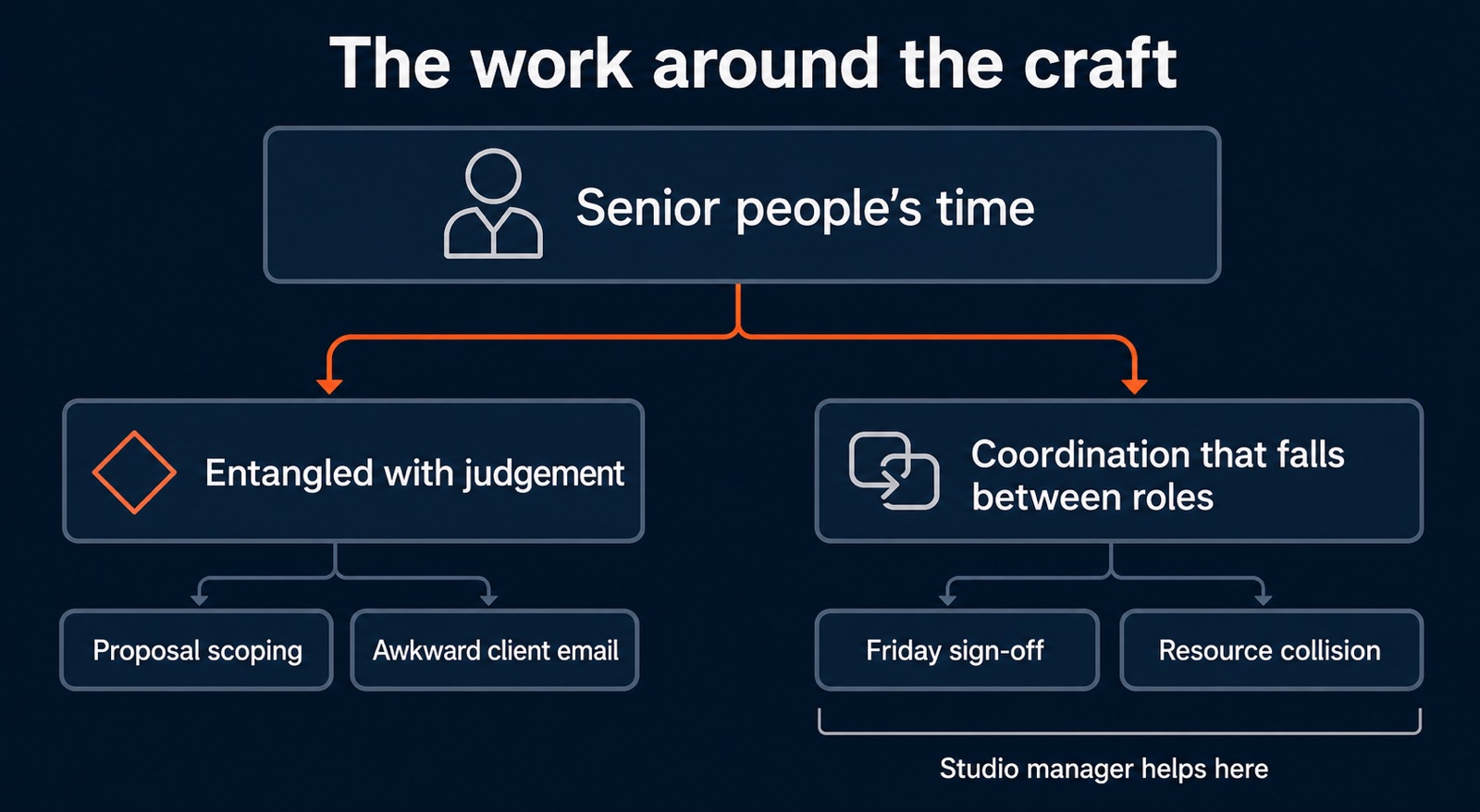
This is not a discipline problem. It is structural, and the non-craft work tends to take one of two forms.
Some of it is entangled with judgement that only senior people have. A proposal needs the founder's scoping instinct, while an awkward client email needs someone who understands the relationship.
The rest is coordination that falls between roles because it does not arrive in role-sized chunks. A Friday sign-off chase or a resource collision may be too small and irregular to justify another role, but it still lands on a senior person's desk.
A studio manager helps with the coordination. But the hire moves that work rather than removing it, and it does not remove the judgement-heavy part. We made the staffing-granularity argument in more detail in How Many AI Agents Do You Actually Need?.
When a point tool stops being enough
A prompt library, point tool, or internal agent may be enough for one bounded task. If that solves the problem, keep it.
But when the work crosses design files, research, client communications, CRM records, project state, and approvals, a chat window and a stack of prompts are no longer the whole answer. The agency needs a system built around how it actually works and integrated into the tools the team already uses.
For a design agency, an Agentic OS is the layer above those tools: the agents, integrations, data, evaluations, and governance that carry work around the craft while senior people keep the decisions that depend on their judgement.
What the system could take on
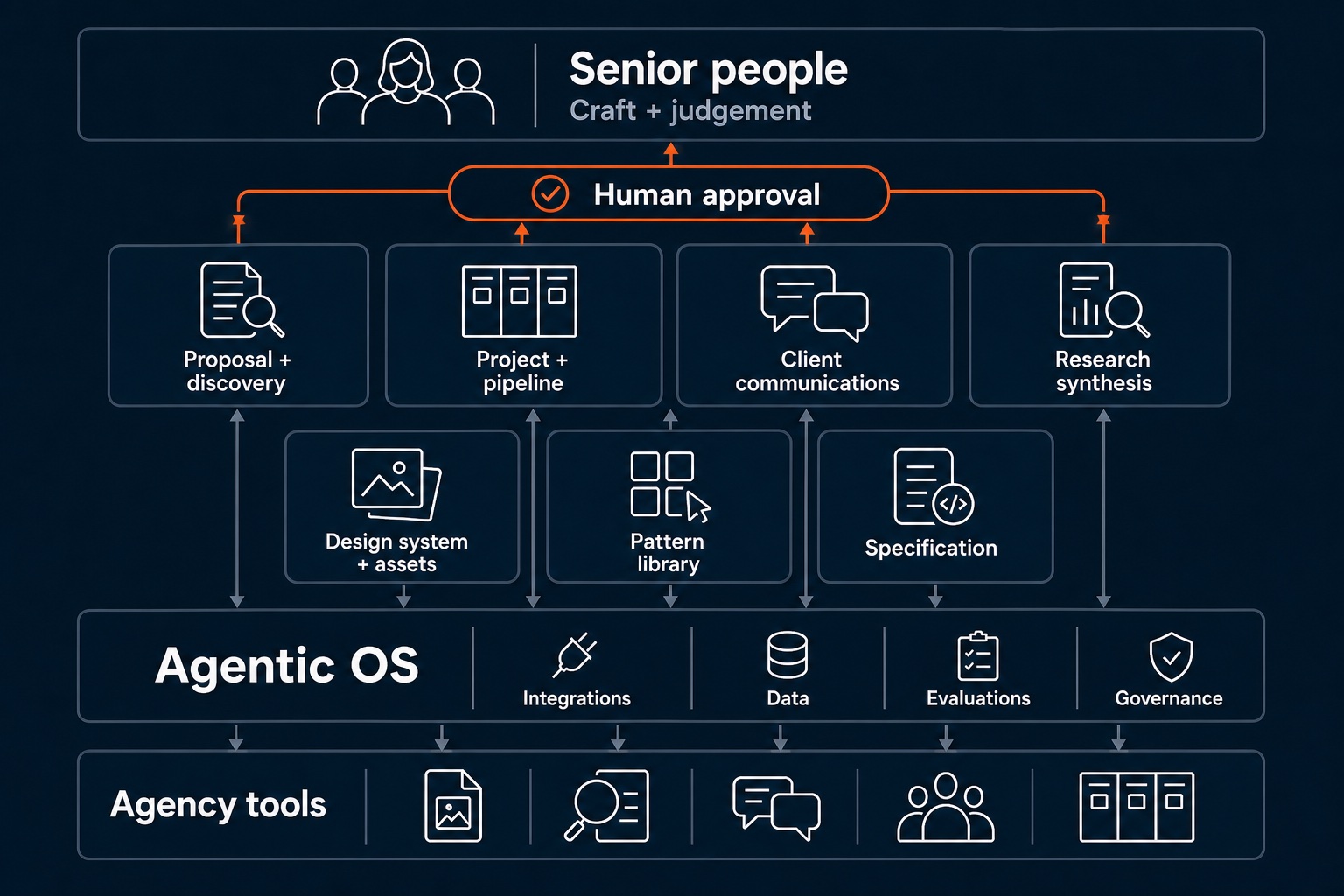
The exact system should be tailored to the agency, but a useful starting constellation could include:
- A proposal and discovery agent that drafts proposals and scopes from a brief and retrieves relevant past work. Founders keep the conversations that win the work.
- A project and pipeline agent that watches delivery, dependencies, and capacity, and does not forget the follow-up a busy team misses.
- A client-communications agent that chases sign-off and drafts the awkward email in the agency's voice, with a person approving what goes out.
- A research-synthesis agent that turns hours of interviews into themed insights and makes them searchable across projects.
- A design-system and asset agent that maintains documentation, flags inconsistencies, and supports accessibility review against agreed criteria such as relevant WCAG 2.2 checks. Compliance with the European Accessibility Act requires separate scoping and review.
- A pattern-library agent that makes years of work searchable in plain language.
- A specification agent, for agencies that hand off to developers, with two skills: preparing the specification package, then producing a prototype after the designer signs off.
The point is not to remove senior people from the process. It is to give them more time for the craft and judgement the client is paying for. That is the gap an Agentic OS closes.
Four reasonable questions
We face four objections when pitching so let's address them up front.
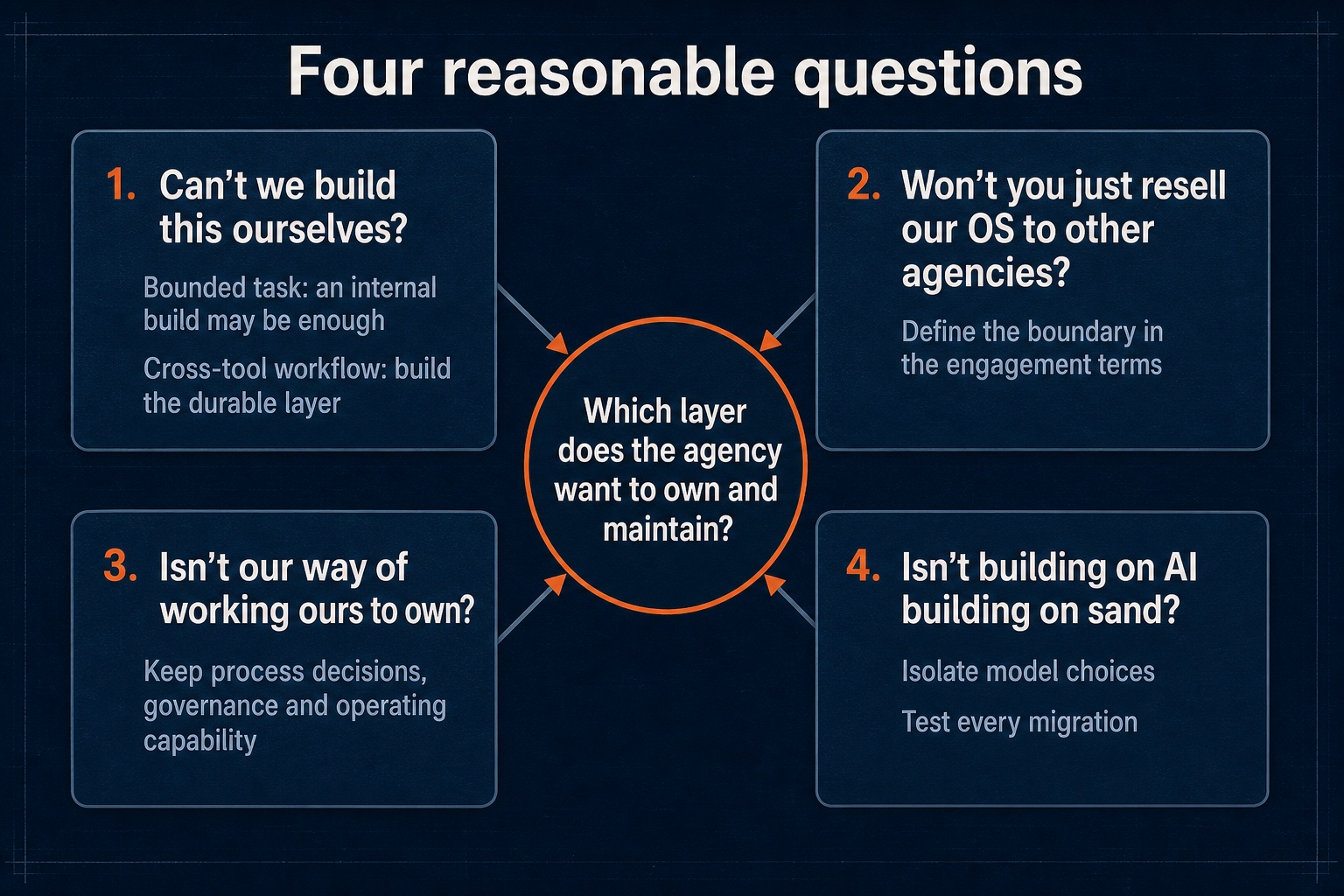
1. Can't we build this ourselves?
Yes, partly. A capable team can get a single agent working internally, and a design agency's process knowledge is a genuine head start.
The useful diagnostic is where the improvement comes from. If an internal agent gets better only when a new model ships, the team may not yet have built the durable layer around it: integrations, state and memory, evaluations, approval design, and maintenance.
Uber's CTO described hand-picking roughly 30 AI-proficient engineers and pairing them with domain experts in short, embedded pods. Uber's scale does not transfer directly to a 5–30-person agency, but the method does: work inside the workflow with the people who understand it.
The same implementation pattern appears in Ode. In July 2026, Anthropic, Blackstone, and Hellman & Friedman introduced the enterprise AI services firm, backed by an investor consortium that includes Goldman Sachs and Sequoia; TechCrunch reported a $1.5 billion valuation. Ode's model puts engineers inside companies to build tailored AI systems around their operations.
Neither example proves that a design agency needs an external partner. They show that model access and prompt writing are not the whole implementation job.
An agency may still choose to build internally. Then the practical question is whether senior designers should own the integrations, evaluations, governance, and maintenance, or spend that time on the craft.
2. Won't you just resell our OS to other agencies?
Aikin applies reusable methods and architecture patterns across engagements, as any experienced consultancy does. But those patterns are not the agency-specific system.
The boundary should be explicit in the engagement terms before a build starts. The agreement should distinguish reusable methods from the agency's data, client work, voice, pattern library, and process-specific implementation, then define the rights for each.
A competitor could receive similar scaffolding and still not receive the system fitted to another agency. If an agency later wants to turn one of its agents into an offer for its own clients, that should be a separate co-product agreement rather than an assumed right on either side.
3. Isn't our way of working ours to own?
Yes. Ownership here is not only paperwork; it is whether the team can understand the mapped workflow, govern the system, and keep operating it after the engagement.
A point product, internal build, or conventional development partner may be enough when the need is bounded and the team can maintain the result. A done-with-you engagement is useful when the agency wants architecture and integration help without handing away decisions about its process.
Making that process explicit, searchable, and teachable can strengthen the agency's control over it. The engagement terms and technical handover need to match that promise.
4. Isn't building on AI building on sand?
Models and platform features change quickly. Workflows, integrations, data boundaries, evaluations, approval rules, and governance usually change on a different cadence, although none of them is static.
A sound architecture isolates model-specific choices where practical. That can make a new model a contained migration rather than a complete rebuild, but it is still a change to test, not a one-click swap.
This worry also points back to the first question. An internal build absorbs the same platform churn, so the decision is not whether the sand exists; it is which layer the agency wants to own and maintain.
How Aikin starts
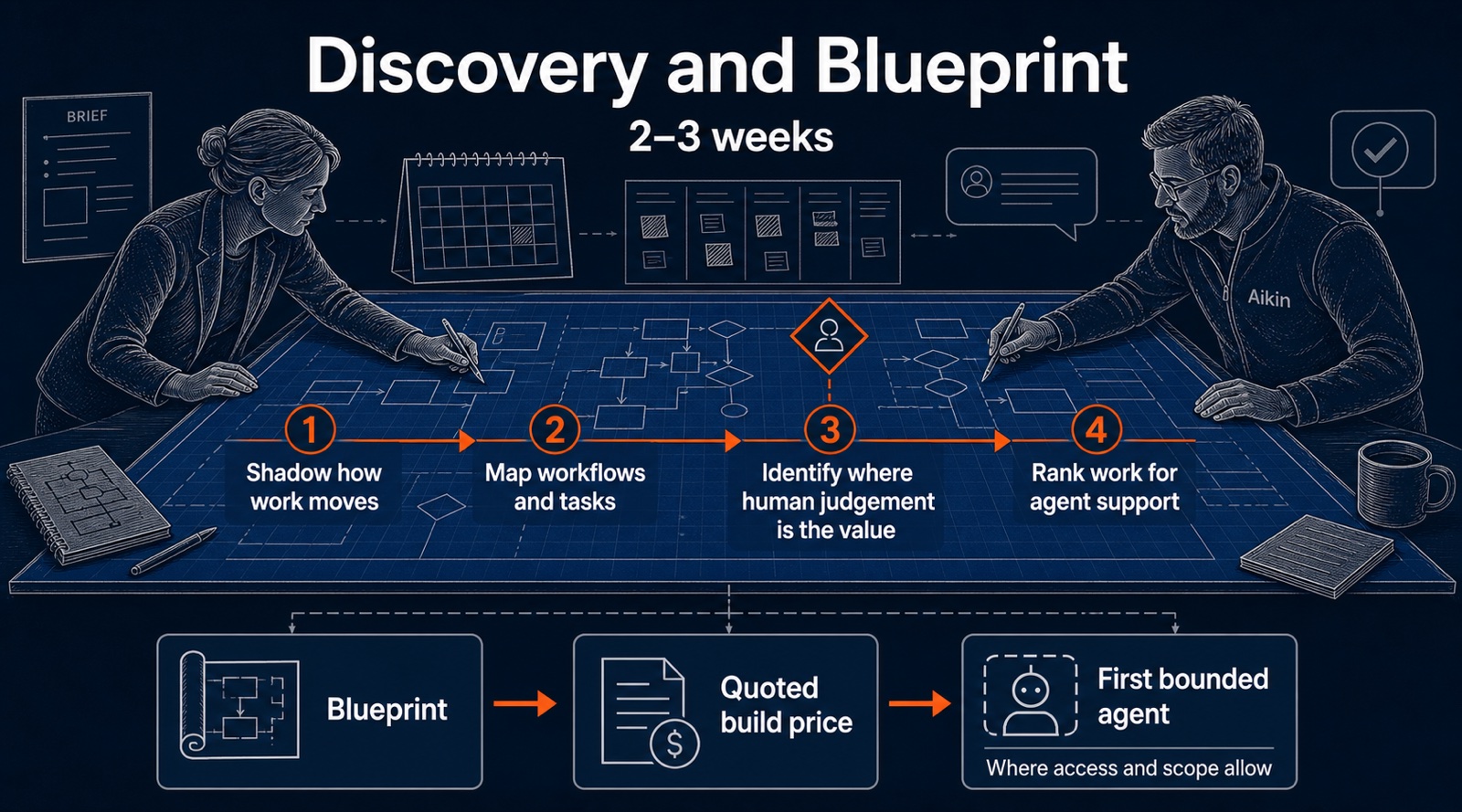
Aikin starts with a two-to-three-week Discovery and Blueprint engagement. We shadow how work moves, map the workflows and tasks, identify where human judgement is the value, and rank the remaining work for agent support.
The agency leaves with the blueprint and a quoted build price whether or not it continues. Where access and scope allow, the first bounded agent also goes live in the agency's own tools during discovery.
Taking work around the craft off senior people does not mean taking them out of the process. It means deciding which parts need their judgement, which parts need coordination, and which parts a system can carry reliably.
Look at last week's calendar again. If it was mostly work around the craft, book a discovery conversation.
~ From Nicholas O'Neill and the Aikin team.
FAQ
What is an agentic operating system for a design agency?
An agentic operating system for a design agency is the layer above its AI tools — the agents, integrations, data foundation and governance that take on the work around the craft (proposals, coordination, client communication, design-system upkeep) so the senior people stay on the design.
Where does a design agency's senior time actually go?
Largely to the work around the craft: proposals, pitching, scoping, coordination between projects, chasing client sign-off, and keeping the design system honest. It is necessary work, but it is not the craft the client is buying.
Why doesn't hiring fix it?
The non-craft work does not arrive in role-sized chunks. A hire such as a studio manager helps with coordination but moves that work rather than removing it, and the judgement-entangled half — scoping instinct, client relationships — cannot be delegated to a new role at all.
What stays human?
The craft and the judgement. Senior people keep the conversations that win work, the decisions that shape it, and approval over what leaves the building. The system exists so they spend more of their week on exactly that.
How does an engagement start?
With a two-to-three-week Discovery and Blueprint engagement: Aikin shadows how work moves, maps the workflows, and ranks the work for agent support. The agency keeps the blueprint and a quoted build price whether or not it continues, and where access and scope allow, the first bounded agent goes live during discovery.